
Serro AI
Serro AI is the elite coordination layer that keeps human-agent teams aligned with live, shared program memory.
Visit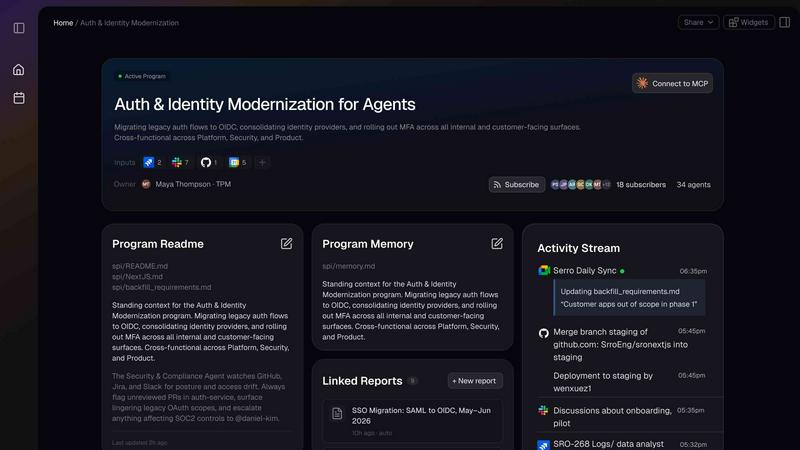
About Serro AI
Serro AI is an agentic Technical Program Management (TPM) infrastructure, purpose-built for the modern Technical Program Management function. It is the first coordination layer designed for human-agent teams, transforming how engineering organizations manage complex programs. Unlike traditional task trackers, roadmap tools, documentation platforms, dashboards, code-wikis, or generic project management systems, Serro treats programs as first-class units of work. It ingests scattered execution signals from Jira, GitHub, Linear, Slack, documents, meetings, and roadmaps, converting them into two core outputs: trusted temporal program memory and real-time status coordination. Program memory is a living record of shared goals, decisions, risks, dependencies, and history that stays current automatically. Status coordination provides actionable intelligence that both humans and AI agents can act upon. Serro meets teams where they already work, allowing users to speak to it in meetings, message it in chat, and command it from existing tools. The platform comes in two editions. Serro Pro helps enterprises scale existing TPM capacity, enabling TPMs, engineering managers, product managers, and engineering leaders to collaboratively manage downstream program execution and agent loops. Serro Lite gives earlier-stage companies AI-powered TPM capacity much earlier, allowing smaller teams to scale their live coordination without significant overhead. Built by operators for the next generation of engineering teams, Serro addresses the fundamental bottleneck that has emerged as AI increases code output but coordination has not scaled proportionally. It is the operating system for organizations where human expertise defines direction and AI accelerates execution.
Features of Serro AI
Program Memory
Live memory across every active program. Serro continuously maintains a dynamic, living record of each program's state, including decisions made, risks identified, ownership assignments, historical activity, and current dependencies. This memory is automatically updated as work progresses across connected tools, eliminating the need for manual status updates or context reconstruction. Teams can query any program at any time to understand its complete history and current status, ensuring that critical context is never lost and that new team members or AI agents can quickly get up to speed. This feature transforms scattered execution signals into a trusted, centralized source of truth that persists across the entire program lifecycle.
Loops on Programs
Intelligent loops that keep complex work moving. Serro automates the repetitive coordination cycles that consume technical program managers' time, such as status tracking, dependency management, and follow-up actions. These loops operate continuously, scanning across connected tools to identify blockers, surface risks, and ensure that action items are completed. For example, after a meeting, Serro can automatically extract decisions and action items, assign owners, and track progress until completion. This feature enables TPMs to manage multiple programs simultaneously without being overwhelmed by coordination overhead, as the system handles the routine but essential coordination work in the background.
Agent Governance
The control layer for programs and agents. As organizations deploy more AI agents to assist with execution, Serro provides a governance framework that ensures agents operate within defined boundaries. This includes setting permissions for what agents can access, defining rules for how agents should interact with program memory, and establishing approval workflows for agent-generated actions. The governance layer maintains human oversight while enabling agents to take meaningful action on programs. This is critical for enterprises that want to scale agentic workflows without losing control or introducing risk, ensuring that agent actions align with organizational policies and program objectives.
Program Analytics
A system-level view across the organization. Serro provides comprehensive analytics that give engineering leaders and executives a real-time picture of organizational health, momentum, blockers, coordination gaps, and operational risk. Instead of fragmented updates from multiple tools, leaders get a unified view of program progress, resource allocation, and delivery velocity. Analytics are calibrated for high-velocity work environments, surfacing patterns and trends that might otherwise go unnoticed. This feature enables faster, more informed decision-making by transforming raw coordination data into actionable intelligence about the organization's operational reality.
Use Cases of Serro AI
Technical Program Manager Delegation
Technical program managers use Serro to delegate coordination overhead and scale their impact. Instead of spending hours manually tracking status, chasing updates, and reconciling information across tools, TPMs can rely on Serro to maintain program memory and automate coordination loops. This allows them to run more cross-functional programs simultaneously, keeping timelines, blockers, ownership, and reporting aligned in one live view. Serro acts as a force multiplier, enabling experienced TPMs to apply their expertise to strategic program direction rather than administrative coordination.
Engineering Manager Visibility
Engineering managers use Serro to understand reality without chasing updates. They can see what is moving across teams, where execution is slipping, and what needs attention next. The platform provides a shared view of work that keeps managers close to delivery, risk, and team health. Instead of relying on status meetings or manual reports, engineering managers can query any program at any time to get an accurate, current picture of progress. This reduces the cognitive load of managing multiple teams and enables proactive intervention before issues escalate.
Product Manager Alignment
Product managers use Serro to keep decisions, timelines, and execution aligned. As product priorities evolve and roadmaps shift, Serro ensures that teams remain coordinated. The platform connects roadmap shifts, decisions, ownership, and delivery progress in one place. Product managers can see how changes in one area affect dependencies across the organization, and they can ensure that product direction is tied to actual execution reality. This prevents the common disconnect between strategic planning and tactical delivery, enabling more responsive product development.
Engineering Leadership Oversight
Engineering leaders and executives use Serro to see organizational health in real time. They get a clearer view of momentum, blockers, coordination gaps, and operational risk across all programs. Instead of fragmented updates from multiple sources, leaders get a live picture of program health that enables faster decisions. This is particularly valuable for organizations running multiple concurrent programs, as it allows leadership to identify systemic issues, allocate resources effectively, and make strategic decisions based on accurate, up-to-date information about the organization's coordination reality.
Frequently Asked Questions
How does Serro differ from traditional project management tools?
Serro is fundamentally different from task trackers, roadmap tools, dashboards, code-wikis, and generic project management platforms. Traditional tools treat tasks or projects as the primary unit of work, requiring manual updates and context switching across multiple systems. Serro treats programs as first-class units of work and automatically ingests execution signals from tools like Jira, GitHub, Linear, Slack, and Notion. It creates a living program memory that stays current without manual effort, and provides real-time status coordination that both humans and AI agents can act on. Serro is purpose-built for the technical program management function in the age of human-agent teams.
What tools does Serro integrate with?
Serro integrates with the tools engineering teams already use, including Slack, Linear, GitHub, Jira, Zoom, Notion, email, and codebases. It ingests signals from these tools to build program memory and coordination intelligence. Users can interact with Serro through these existing interfaces, speaking to it in meetings, messaging it in chat, and commanding it from their tools. The platform is designed to meet teams where they already work, minimizing disruption while maximizing coordination value. Additional integrations are continuously being added based on customer needs.
Is Serro suitable for smaller teams or only large enterprises?
Serro offers two editions to serve organizations at different stages. Serro Pro is designed for enterprises that need to scale existing TPM capacity, enabling TPMs, engineering managers, product managers, and engineering leaders to collaboratively manage downstream program execution and agent loops. Serro Lite gives earlier-stage companies AI-powered TPM capacity much earlier, allowing smaller teams to scale their live coordination without significant overhead. Both editions deliver the core program memory and coordination capabilities, with Pro offering additional features for larger, more complex organizations.
How does Serro handle AI agent governance?
Serro includes a dedicated Agent Governance system that serves as the control layer for programs and agents. As organizations deploy AI agents to assist with execution, Serro provides a framework for setting permissions, defining rules, and establishing approval workflows. This ensures that agents operate within defined boundaries and align with organizational policies. The governance layer maintains human oversight while enabling agents to take meaningful action on programs. This is essential for enterprises that want to scale agentic workflows without introducing risk or losing control over program execution.
Similar to Serro AI
layahost
Moderation, routing, intent and scoring for any text over one Jev-compatible API, hosted in the EU.


Motion Control AI
Create motion-controlled character videos by transferring dance, gestures, timing, and camera movement from a reference video.

amaze.directory
A directory of AI tools where every listing was opened and used by a person first. Search by job, filter by price, get the link.
Speechyou
AI transcription for voice notes, meetings, and audio files in 1,700 languages, with AI summaries and subtitle export and unlimited chat ai usage.