
HiAPI
HiAPI delivers elite unified access to leading image, video, and audio generation models with persistent storage and production-grade reliability.
Visit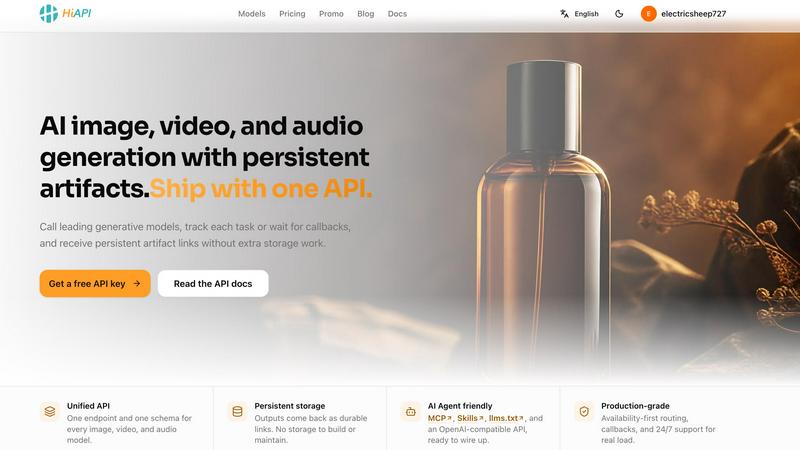
About HiAPI
HiAPI is an elite, developer-first AI API platform architected for the generation of images, video, and audio. It serves as a unified gateway, granting developers access to a curated portfolio of the world's most advanced generative models through a single, elegant interface. The core proposition is radical simplicity: one API key, one unified billing system, and a pay-as-you-go pricing model eliminate the friction of managing multiple vendor accounts and integrations. HiAPI is designed for top-tier engineering teams and AI agents who demand production-grade reliability, persistent storage without overhead, and the flexibility to choose the best model for each specific task. Beyond mere API access, the platform provides a comprehensive lifecycle for every generation task, from submission to callback, ensuring outputs are delivered as durable, persistent artifact links. This eliminates the need for developers to build and maintain their own storage infrastructure. With support for OpenAI-compatible requests, HiAPI offers an immediate, familiar integration path for any developer. The platform is also natively AI agent-friendly, featuring MCP tools, reusable Skills, and an llms.txt file, making it the definitive, premium choice for powering sophisticated, multimodal generative workflows at scale.
Features of HiAPI
Unified API and One-Click Model Access
HiAPI provides a single, standardized endpoint for every image, video, and audio model in its roster. Developers call any model by simply passing its name as a parameter, eliminating the need to learn different schemas, authentication methods, or SDKs for each provider. This unified architecture drastically reduces integration time and code complexity, allowing elite teams to rapidly prototype and ship generative features. The platform also supports OpenAI-compatible requests, ensuring that existing codebases and familiar patterns work seamlessly, further lowering the barrier to entry for top-tier development teams.
Persistent Artifact Storage
Every output generated through HiAPI is returned as a durable, low-cost, persistent artifact link. This feature is a cornerstone of the platform's value, freeing developers from the burden of building, securing, and maintaining their own object storage systems. Whether generating a single image or a batch of videos, the output is immediately accessible via a stable URL. This not only simplifies the development pipeline but also ensures that generated content remains available for future use, distribution, or retrieval, a critical requirement for production applications and AI agent workflows.
Production-Grade Task Lifecycle
HiAPI introduces a sophisticated, asynchronous task lifecycle that is built for reliability. Each generation request is submitted as a task, returning a unique ID. Developers can then poll for status or, more elegantly, set up a webhook callback URL to be notified upon completion. The system also supports idempotency keys, ensuring that retrying a request does not create duplicate tasks. This architecture is designed for high-load, mission-critical applications where data integrity and operational efficiency are paramount, providing the control and observability that elite engineering teams demand.
AI Agent-Native Architecture
HiAPI is purpose-built for the age of autonomous agents. It provides an llms.txt file that allows any agent to instantly understand the platform's capabilities and API structure. Beyond that, it offers Remote MCP tools and reusable Skills, which are pre-configured instructions for common workflows. This allows agents like Claude, Cursor, and Codex to discover, call, and compose HiAPI's generative models with minimal setup. This forward-thinking design positions HiAPI as the premier infrastructure layer for building the next generation of intelligent, multimodal applications.
Use Cases of HiAPI
High-Volume Content Generation for Marketing
Marketing teams can leverage HiAPI to generate a vast library of on-brand images and promotional videos at scale. By using the unified API, they can route different creative tasks to the most suitable model, such as using GPT Image 2 for text-intensive social media graphics and Seedance 2.0 for cinematic video ads. The persistent storage feature ensures all assets are immediately available for download or integration into ad servers, while the predictable pay-as-you-go pricing allows for precise cost management across large campaigns.
Building Multimodal AI Agents and Assistants
Developers can integrate HiAPI into their AI agents to grant them powerful generative capabilities. An agent can be instructed to use HiAPI to create an image to accompany a blog post, generate a short video summary of a report, or compose a background music track for a presentation. The agent-native features, like llms.txt and Skills, make this integration trivial. The agent can discover the available models, submit a task, and use the callback mechanism to wait for the result, all without human intervention, creating a seamless and autonomous content creation pipeline.
Dynamic Content Generation for Applications
Software applications can use HiAPI to generate personalized, dynamic content for their users. For example, an e-commerce platform could generate unique product images on the fly based on user preferences, or a social media app could offer users the ability to create custom avatars or stickers. The low latency and high reliability of the platform, combined with the simplicity of the one-key API, make it ideal for embedding generative AI directly into user-facing features, enhancing engagement and personalization without bloating the core application code.
Rapid Prototyping and Creative Exploration
Design studios and creative agencies can use HiAPI as a powerful tool for rapid prototyping. A creative director can quickly generate dozens of visual concepts using FLUX 1.1 Pro, then use Seedream 5.0 Pro to edit and refine the chosen concept. The unified billing and transparent pricing allow teams to experiment freely without worrying about hidden costs or complex vendor contracts. This accelerates the creative feedback loop, enabling teams to iterate on ideas faster and present a wider range of high-fidelity concepts to clients.
Frequently Asked Questions
What is the core benefit of using HiAPI over directly calling individual AI model APIs?
The primary benefit is the radical simplification of your infrastructure. HiAPI provides a single API key, a unified billing system, and a consistent API schema for all models. This eliminates the need to manage multiple vendor accounts, learn different APIs, and handle separate payments. Furthermore, HiAPI provides persistent artifact storage, removing the need to build your own storage system, and offers a production-grade task lifecycle with callbacks and idempotency, which is a significant engineering effort to build and maintain independently.
How does the persistent artifact storage work?
When you submit a task with the storage parameter set to persistent, the generated output (image, video, or audio) is stored on HiAPI's infrastructure and returned as a durable, low-cost URL or link. This link remains active and accessible, allowing you to reference the artifact without needing to download and re-host it yourself. This feature is designed to eliminate the overhead of managing your own object storage (like S3) and simplifies distribution and retrieval of generated content.
Is HiAPI compatible with existing OpenAI SDKs and code?
Yes, HiAPI supports OpenAI-compatible requests. This means you can often use your existing OpenAI client libraries and code patterns to interact with HiAPI's models, simply by changing the base URL and API key. This design choice ensures a frictionless migration path for developers already familiar with the OpenAI ecosystem, allowing them to leverage HiAPI's broader model selection and advanced features with minimal code changes.
How does HiAPI support integration with AI agents?
HiAPI is designed to be natively AI agent-friendly. It provides an llms.txt file that acts as a machine-readable documentation index, allowing an agent to instantly understand the platform's capabilities. Additionally, it offers Remote MCP tools and reusable Skills. An agent can use these to discover models, understand API parameters, and execute complex generation workflows autonomously, making HiAPI a powerful backend for autonomous content creation and task execution.
Similar to HiAPI

ImageGPT
ImageGPT is an all-in-one AI creative platform for generating, editing and transforming images and videos using AI.

AI Album Cover Maker
Create release-ready album covers from a prompt or photo. Generate, refine, and export art for singles, EPs, mixtapes, and playlists.
Sprite Sheet Maker
A free browser-based toolkit for creating, cutting, converting, and previewing sprite sheet animations.
AIEnhancer
Enhance photos, create images, and generate videos with flexible AI workflows, creative effects, production-tested models, and a shared asset library.

Flux Lora
Explore Flux LoRA workflows online, with a roadmap for model discovery, generation, and guided training.

Vynzo
AI image and video studio. Generate from a prompt, animate stills, swap faces, restyle clips and edit — one credit pool, no subscription.

ProfileLoom
ProfileLoom turns one photo into platform-ready AI portraits for professional, social, and creator profiles, with presets and built-in editing.