
diffray vs Fallom
Side-by-side comparison to help you choose the right tool.

diffray
Diffray's elite AI agents pinpoint real code flaws with surgical precision, eliminating false positives.
Last updated: February 28, 2026

Fallom delivers elite, real-time observability and compliance for your AI agents and LLM operations.
Last updated: February 28, 2026
Visual Comparison
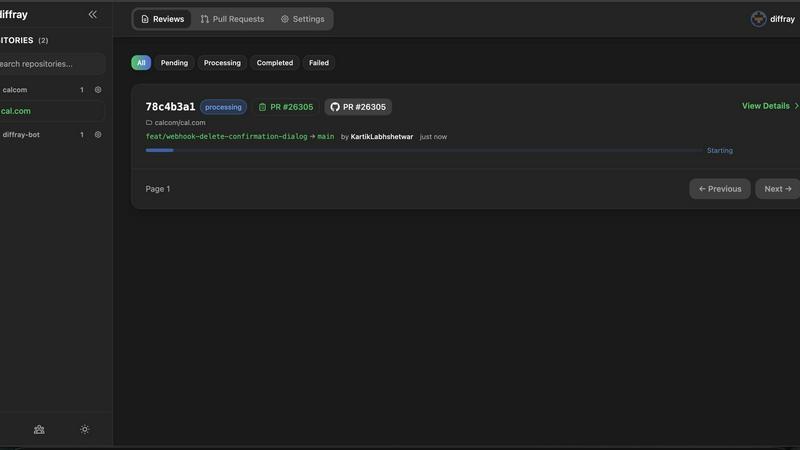
diffray
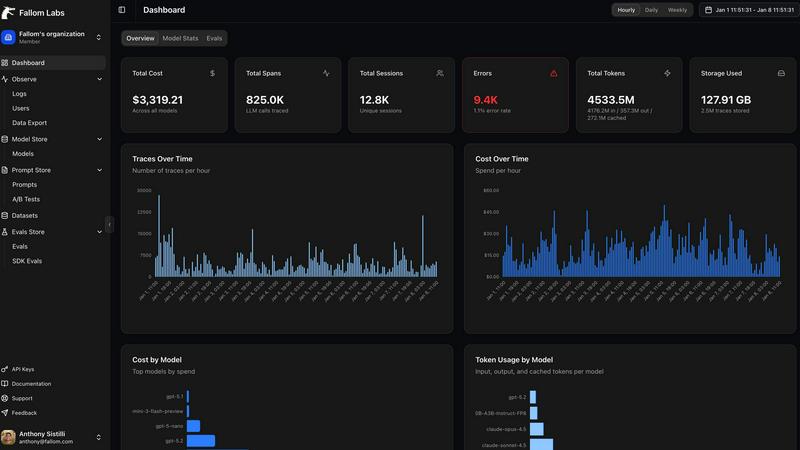
Fallom
Feature Comparison
diffray
Multi-Agent Specialized Architecture
At the core of diffray is a revolutionary multi-agent system featuring over 30 meticulously trained AI agents. Each agent is an expert dedicated to a specific facet of code quality, such as security analysis, performance optimization, bug detection, adherence to best practices, and SEO. This division of labor ensures unparalleled depth and accuracy, moving far beyond the superficial, noisy feedback generated by generic, single-model alternatives. It is this architecture that enables the platform's exceptional precision and relevance.
Context-Aware Code Analysis
diffray does not operate in a vacuum. It intelligently analyzes pull requests within the full context of your existing codebase, not just the isolated changes. This deep contextual understanding allows it to identify issues that are invisible to diff-only tools, such as breaking changes, inconsistencies with established patterns, and integration problems. The feedback provided is therefore profoundly relevant and actionable, directly tied to your project's unique architecture and standards.
Drastic Noise Reduction & Precision
Leveraging its specialized agents, diffray delivers an industry-leading 87% reduction in false positives compared to standard AI review tools. This means developers spend virtually no time sifting through irrelevant or incorrect suggestions. Concurrently, the system triples the detection rate of genuine, high-priority issues. This dual achievement of high signal and low noise fundamentally transforms the code review from a chore into a trusted, high-value gatekeeping process.
Accelerated Development Velocity
By providing precise, context-rich feedback instantly, diffray dramatically compresses the review cycle. Teams report cutting their average weekly time spent on PR reviews from 45 minutes down to just 12 minutes. This acceleration unblocks developers, reduces context-switching, and enables faster iteration and deployment. The tool effectively acts as a force multiplier for your engineering team, enhancing productivity without sacrificing an ounce of code quality.
Fallom
End-to-End LLM Tracing
Fallom provides complete, real-time visibility into every LLM call within your agentic workflows. It captures a comprehensive telemetry dataset including the exact prompts submitted, the generated outputs, all intermediate tool or function calls with their arguments and results, token consumption, latency metrics, and the calculated cost for each interaction. This granular trace data is essential for debugging complex chains, understanding performance bottlenecks, and ensuring the deterministic behavior of AI systems in production environments.
Enterprise Cost Attribution & Governance
Gain absolute financial control over your AI expenditures. Fallom meticulously attributes costs across every dimension—by model, individual user, team, or even specific customer—providing full transparency for budgeting, forecasting, and internal chargeback. The platform's real-time dashboards display spend analytics, allowing leaders to monitor budgets, identify unexpected usage patterns, and optimize model selection to balance performance with cost-efficiency at scale.
Compliance-Ready Audit Trails
Engineered for regulated industries, Fallom automatically generates immutable, complete audit trails for all AI interactions. This includes logging of inputs and outputs, tracking of model versions used in each query, and recording user consent where required. These features are purpose-built to help organizations demonstrate compliance with evolving global standards like the EU AI Act, SOC 2, and GDPR, turning a complex regulatory challenge into a managed operational process.
Advanced Session & Performance Analytics
Move beyond isolated traces to understand the full user journey. Fallom intelligently groups related traces into sessions, providing context-rich views of complete user interactions. Coupled with timing waterfall visualizations, teams can dissect multi-step agent workflows to pinpoint exactly where latency occurs—whether in an LLM call, a tool execution, or internal logic—dramatically accelerating performance optimization and root cause analysis.
Use Cases
diffray
Enterprise-Grade Security Auditing
For organizations handling sensitive data or operating in regulated industries, diffray's specialized security agents act as a first line of defense. They automatically scan every pull request for a vast array of vulnerabilities—from injection flaws and insecure dependencies to misconfigurations and secrets exposure—ensuring compliance and robust security posture are maintained with every commit, long before code reaches production.
Performance-Critical Application Development
Teams building high-traffic services or resource-constrained applications utilize diffray to enforce performance excellence. Its performance-specialized agents identify inefficient algorithms, memory leaks, costly database queries, and suboptimal rendering patterns during review, preventing performance regressions and optimizing application speed and scalability from the earliest stages of development.
Maintaining Codebase Consistency at Scale
For large engineering teams or sprawling legacy codebases, diffray ensures consistency and adherence to established best practices. Its agents analyze code for style guide violations, architectural anti-patterns, and deviations from internal conventions. This automated governance empowers senior developers and architects to scale their oversight, ensuring code quality remains high even as the team and codebase grow.
Streamlining Onboarding and Peer Reviews
diffray serves as an always-available expert mentor for new team members, providing immediate, constructive feedback on their pull requests that aligns with team standards. This accelerates the onboarding process and reduces the burden on senior developers for basic reviews. It also elevates the quality of human peer reviews by handling routine checks, allowing engineers to focus on complex architectural and design discussions.
Fallom
Proactive AI Operations & Incident Response
Engineering and SRE teams use Fallom for live monitoring and alerting on their AI-powered applications. By observing real-time traces, latency metrics, and error rates, they can detect anomalies, performance degradation, or hallucination spikes before they impact end-users. When issues occur, the detailed trace context enables rapid triage and resolution, minimizing downtime and ensuring service reliability for critical AI features.
Financial Optimization & Showback
Finance and engineering leadership leverage Fallom's precise cost attribution to manage and forecast AI spend. By analyzing costs per model, team, or product feature, organizations can eliminate waste, make data-driven decisions on model selection (e.g., GPT-4 vs. GPT-4o-mini), and implement accurate showback or chargeback mechanisms to align resource usage with business unit budgets.
Regulatory Compliance & Risk Auditing
Compliance, legal, and security teams rely on Fallom to fulfill stringent regulatory requirements for AI systems. The platform's automated audit trails, consent tracking, and versioning provide the necessary evidence for audits. Privacy modes allow sensitive data to be redacted while maintaining full telemetry, enabling organizations to deploy AI confidently in healthcare, finance, and other regulated sectors.
AI Product Development & Evaluation
AI product managers and developers utilize Fallom for iterative improvement and safe deployment. Features like the Prompt Store enable version control and A/B testing of prompt variations. Integrated evaluations track key metrics like accuracy and hallucination rates across model versions, allowing teams to validate improvements, catch regressions, and roll out new models with confidence using controlled traffic splitting.
Overview
About diffray
diffray represents the pinnacle of intelligent code review, engineered for elite software development teams who refuse to compromise on velocity or quality. It transcends the limitations of conventional, single-model AI review tools by deploying a sophisticated multi-agent architecture. This system comprises over 30 hyper-specialized AI agents, each a master in its domain—from deep-seated security vulnerabilities and performance bottlenecks to subtle bugs, architectural best practices, and even SEO considerations for web applications. This surgical precision results in a revolutionary 87% reduction in false positives while tripling the detection of legitimate, critical issues. Unlike tools that merely scan diffs, diffray possesses a profound understanding of your entire codebase context, ensuring every piece of feedback is not just accurate but immediately actionable. The outcome is a transformative acceleration of the development lifecycle: teams can slash their average weekly PR review time from 45 minutes to a mere 12 minutes. diffray is the definitive tool for engineering leaders and developers dedicated to achieving peak operational efficiency, impeccable code integrity, and a significant competitive advantage in software delivery.
About Fallom
Fallom is the definitive enterprise observability platform engineered exclusively for the age of AI. It provides mission-critical visibility into the complex, black-box nature of large language model (LLM) and autonomous agent workloads running in production. For elite engineering, data science, and compliance teams, Fallom transforms opaque AI operations into a transparent, manageable, and fully auditable system. Its core value lies in delivering unparalleled, end-to-end tracing of every LLM interaction, capturing granular details from prompts and outputs to tool calls, token usage, latency, and precise cost attribution. Beyond mere monitoring, Fallom provides essential business context by grouping traces by session, user, or customer, enabling rapid debugging and insightful analytics. Built with enterprise-grade compliance as a first principle, it features immutable audit trails, model versioning, and consent tracking to navigate stringent regulations like the EU AI Act and GDPR. With its OpenTelemetry-native SDK, integration is seamless, offering teams immediate live monitoring, powerful cost controls, and the confidence to scale sophisticated AI applications with reliability and fiscal precision.
Frequently Asked Questions
diffray FAQ
How does diffray's multi-agent system differ from other AI code reviewers?
Unlike tools that use a single, generalized AI model, diffray employs a fleet of over 30 specialized agents. Think of it as having a dedicated team of experts: one is a world-class security researcher, another a performance tuning specialist, another a bug detection savant, and so on. Each agent is finely tuned for its specific domain, leading to dramatically higher accuracy, deeper analysis, and far less irrelevant noise compared to a "jack-of-all-trades" model.
What kind of integrations does diffray support?
diffray is designed to seamlessly integrate into modern development workflows. It connects directly with popular Git hosting platforms like GitHub, GitLab, and Bitbucket. Once integrated, it automatically analyzes pull requests and posts contextual comments directly on the relevant lines of code, requiring no change to your existing team process. It works alongside your current CI/CD pipelines and project management tools.
Is diffray suitable for small development teams or startups?
Absolutely. While delivering enterprise-grade analysis, diffray is incredibly valuable for small teams and startups where engineering resources are precious. It acts as a force multiplier, providing expert-level review coverage that a small team could not otherwise afford. The dramatic time savings and quality assurance it provides are critical for startups moving fast without breaking things, enabling them to punch above their weight in code quality.
How does diffray handle the privacy and security of our source code?
diffray is built with enterprise-grade security principles. The analysis can be configured based on your security requirements. For the highest level of privacy, an on-premises deployment option is available, ensuring your source code never leaves your infrastructure. For cloud users, data is encrypted in transit and at rest, and strict access controls and compliance protocols are maintained to protect your intellectual property.
Fallom FAQ
How does Fallom integrate with my existing AI applications?
Fallom offers an OpenTelemetry-native SDK designed for seamless integration. You can instrument your LLM and agent code in under five minutes. The SDK is provider-agnostic, working with any model from OpenAI, Anthropic, Google, or open-source providers, ensuring zero lock-in and compatibility with your existing tech stack and workflows.
How does Fallom handle sensitive or private user data?
Fallom is built with enterprise-grade privacy controls. It offers a configurable Privacy Mode that allows you to disable full content capture for sensitive interactions. You can choose to log only metadata (like token counts and latency) or apply content redaction rules, ensuring you maintain full observability for debugging while protecting confidential user information and complying with data protection policies.
Can Fallom help us reduce our overall LLM costs?
Absolutely. Fallom provides the granular visibility necessary for cost optimization. By tracking spend per model, per feature, and per user, you can identify inefficiencies—such as overusing expensive models for simple tasks. Insights into token usage and performance allow you to right-size model selection, implement usage policies, and monitor the financial impact of changes in real time, leading to significant cost savings.
Is Fallom suitable for monitoring complex, multi-step AI agents?
Yes, this is a core strength of Fallom. It automatically traces the entire execution chain of sophisticated agents, visualizing each step—LLM calls, tool executions, and conditional logic—in a unified timeline or waterfall view. This end-to-end context is critical for debugging failures in long-running workflows, understanding the provenance of an output, and optimizing the overall latency and reliability of autonomous agent systems.
Alternatives
diffray Alternatives
diffray represents the pinnacle of AI-powered code review, a sophisticated tool engineered for development teams who prioritize precision and efficiency. It operates within the elite category of intelligent development automation, leveraging a multi-agent architecture to deliver unparalleled, context-aware analysis that transcends simple diff checking. Even the most advanced solutions may prompt exploration of alternatives. This is often driven by specific budgetary frameworks, the need for integration within a particular tech stack, or a desire to compare feature sets against highly specialized point solutions. For discerning teams, the evaluation extends beyond basic functionality. When assessing other options, the critical benchmarks are accuracy and actionable intelligence. The foremost consideration should be a solution's ability to minimize false positives while maximizing genuine issue detection. Equally vital is the tool's capacity for deep, codebase-aware analysis that provides contextual feedback, not just generic commentary. The ultimate goal is to elevate code quality without introducing noise into the development workflow.
Fallom Alternatives
Fallom is the definitive AI-native observability platform, engineered for the elite demands of enterprise-scale LLM and agent operations. It delivers unparalleled, real-time visibility into every facet of production AI, from granular call tracing to stringent compliance assurance. Organizations may explore alternatives for various strategic reasons, such as aligning with specific budget frameworks, integrating into an existing technology stack, or requiring a different balance between depth of features and implementation simplicity. The landscape offers varied approaches to monitoring and governance. When evaluating an alternative, discerning enterprises should prioritize solutions that offer genuine end-to-end traceability, robust cost attribution models, and ironclad compliance tooling. The platform must not only provide data but contextual, actionable intelligence that scales with your AI ambitions.