
CCAPI vs Renderly
Side-by-side comparison to help you choose the right tool.

CCAPI
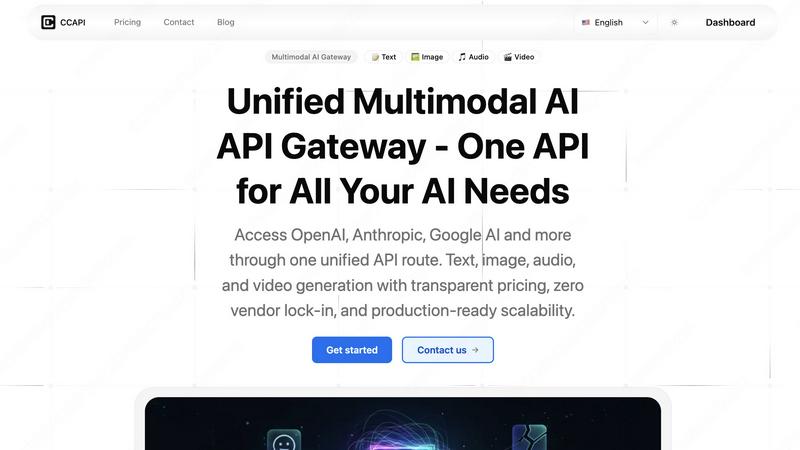
CCAPI is your exclusive, always-on gateway to every major AI model through one unified API.
Last updated: February 28, 2026

Renderly
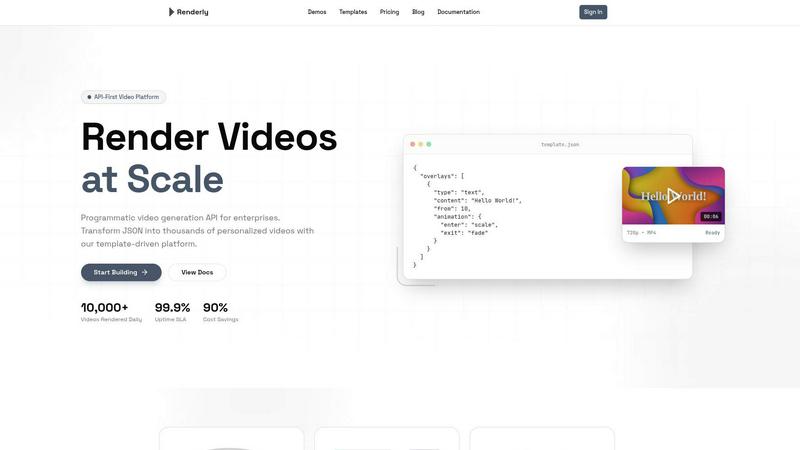
Renderly is the enterprise API for generating thousands of personalized videos programmatically.
Last updated: February 28, 2026
Visual Comparison
CCAPI
Renderly
Feature Comparison
CCAPI
Unified Multimodal Gateway
CCAPI provides a singular, standardized endpoint for all major AI modalities—text, image, audio, and video. This eliminates the need for developers to integrate and maintain separate APIs for OpenAI's GPT, Anthropic's Claude, Google's Gemini, ByteDance's video models, and dozens of other providers. You interact with one consistent interface, dramatically reducing code complexity and accelerating development cycles for applications that require diverse AI capabilities.
Intelligent Auto-Failover Routing
The platform's sophisticated router continuously monitors the health and performance of all connected AI providers. If a request to a primary model like OpenAI fails or times out, CCAPI automatically and intelligently reroutes the request to a secondary provider, such as Anthropic or Google AI, in approximately 120 milliseconds. This built-in redundancy guarantees a 99.9% uptime SLA, ensuring your end-users experience zero disruption even during widespread provider outages.
OpenAI-Compatible Endpoint
Adopting CCAPI requires virtually zero migration effort. The API is fully compatible with the OpenAI SDK specification. Developers need only change their base URL to https://api.ccapi.ai/v1 and update their API key. All existing code, prompts, and SDK calls (using OpenAI's Python or Node.js libraries, for instance) will continue to work seamlessly, instantly unlocking access to the entire aggregated model ecosystem.
Transparent Usage & Cost Dashboard
CCAPI offers a comprehensive, real-time dashboard that provides crystal-clear visibility into your AI operations. Track costs across all providers and models, monitor latency metrics, and analyze success rates for every request. With true pay-as-you-go pricing, your USD balance is used directly with no credit gimmicks or hidden fees, giving you precise control and understanding of your AI expenditure.
Renderly
Programmatic Video Generation API
The cornerstone of Renderly is its robust, RESTful API designed explicitly for high-volume operations. Developers can programmatically trigger video renders by sending JSON payloads, seamlessly integrating dynamic video creation into existing applications and workflows. The API supports webhooks for asynchronous job status updates and comes with comprehensive SDKs, ensuring a frictionless developer experience for generating personalized videos at an industrial scale without manual intervention.
Template-Driven JSON Configuration
Renderly employs a powerful template system where video designs are defined and controlled via JSON configuration. This allows for dynamic variable replacement, enabling the mass personalization of text, images, and other assets within a video. Teams can create a master template once and then generate infinite variations by simply swapping out data points, ensuring brand consistency while enabling deep personalization across thousands of unique outputs.
Enterprise-Grade Scalable Infrastructure
Built on a cloud-native platform, Renderly's infrastructure automatically scales to handle demand, from a single test render to hundreds of thousands of concurrent jobs. This auto-scaling capability ensures consistent performance and speed regardless of volume, backed by a 99.9% uptime SLA. Enterprises can rely on Renderly for mission-critical video production without worrying about capacity planning or performance degradation during peak loads.
Centralized Template Management & Security
The platform offers a centralized library for managing all video templates with version control, facilitating collaboration and iteration. This is coupled with enterprise-level security protocols, including SOC 2 compliance, data encryption, strict access controls, and audit logging. This feature set ensures that proprietary template designs and sensitive customer data used in personalization are managed securely and efficiently at scale.
Use Cases
CCAPI
Resilient Enterprise AI Applications
For large-scale production applications where downtime is not an option, CCAPI acts as critical infrastructure. Financial analysis tools, customer support chatbots, or content moderation systems can rely on its automatic failover to maintain continuous operation. If one LLM provider has an outage, requests are silently rerouted, ensuring business continuity and a flawless user experience without manual intervention.
Rapid AI Product Prototyping and Development
Startups and development teams building AI-powered products can prototype and iterate at unprecedented speed. Instead of evaluating and integrating APIs from multiple vendors one by one, developers use CCAPI to instantly test and compare the latest models from OpenAI, Anthropic, DeepSeek, and others through a single interface, drastically reducing time-to-market for new features and products.
Cost-Optimized Model Deployment
Developers can strategically leverage CCAPI to optimize for both performance and cost. The platform allows you to configure routing rules or simply choose from a catalog of models with different price-performance ratios. You can route non-critical tasks to high-value models like DeepSeek, while using premium models like Claude-4.6 for mission-critical reasoning, all managed through one billing and monitoring dashboard.
Advanced Multimodal Content Generation
Content creation platforms and marketing tools can harness CCAPI's unified access to generate entire multimedia campaigns. A single workflow can call the API to generate a script (text), create accompanying images, produce a voiceover (audio), and finally render a promotional video using cutting-edge models like Kling 3.0 or Seedance 2.0, all through one integrated pipeline.
Renderly
Personalized Marketing & Communication Campaigns
Enterprises can generate thousands of unique video messages for email marketing, onboarding sequences, or product announcements where each video addresses the recipient by name and includes tailored content. This transforms static communication into engaging, personalized experiences that significantly boost open rates, conversion, and customer loyalty, all automated through Renderly's API.
Bulk Social Media Content Generation
Marketing and social media teams can automate the creation of platform-specific video content for campaigns, product launches, or daily posts. By connecting a data source to Renderly, they can produce hundreds of variations optimized for different segments, regions, or A/B tests, ensuring a constant stream of fresh, on-brand video content without manual design work.
Data-Driven Motion Graphics & Reporting
Transform complex datasets and analytics into compelling, easy-to-understand motion graphics videos. Renderly is ideal for creating automated weekly performance reports, financial summaries, or operational dashboards in video format. Dynamic charts, graphs, and figures are rendered visually, making data dissemination more engaging and accessible for stakeholders and clients.
E-commerce & SaaS Product Integrations
SaaS platforms and e-commerce sites can integrate Renderly's API to offer video generation as a native feature. Examples include creating personalized video summaries for users, automated video receipts for customers, or dynamic explainer videos that showcase specific user data. This adds significant value to the core product and enhances user engagement through customized multimedia.
Overview
About CCAPI
CCAPI is the definitive multimodal AI gateway for elite engineering teams who demand unwavering reliability and uncompromising performance. It consolidates the fragmented landscape of artificial intelligence providers—including OpenAI, Anthropic, Google AI, DeepSeek, ByteDance, and more—into a single, unified, and OpenAI-compatible API endpoint. Designed exclusively for developers, CCAPI provides seamless access to cutting-edge models for text, image, audio, and video generation, eliminating the complexity of managing multiple SDKs, keys, and rate limits. Its core value proposition is operational sovereignty: a 99.9% success rate guaranteed by intelligent, automatic failover routing that instantly switches providers in the event of an outage, ensuring your application never loses a request. With instant access to the latest models like Kling 3.0 and GPT-5 Series, transparent pay-as-you-go pricing, and 24/7 monitoring, CCAPI transforms AI integration from a fragile, multi-vendor chore into a robust, single-point-of-contact infrastructure that is always on.
About Renderly
Renderly is the definitive enterprise-grade video infrastructure platform, engineered for developers and creators who demand programmatic control and unparalleled scale. It transcends traditional video editing by providing a sophisticated API-first architecture that automates the entire video production lifecycle. The core value proposition is transformative: convert simple JSON data into thousands of high-fidelity, personalized videos instantly. This eliminates the manual, time-intensive rendering processes that bottleneck creativity and scalability. Renderly serves a discerning clientele, from growth teams needing dynamic social media campaigns at volume to enterprise developers embedding personalized video generation into customer journeys, SaaS platforms, and data visualization tools. It is built upon a cloud-native foundation guaranteeing 99.9% uptime and auto-scaling performance, ensuring that rendering thousands of concurrent videos is as reliable as rendering one. With a focus on transparent, credit-based pricing that promises up to 90% cost savings, Renderly delivers elite performance without premium waste, positioning itself as the essential infrastructure for the next generation of automated video content.
Frequently Asked Questions
CCAPI FAQ
How does the automatic failover work?
CCAPI's intelligent router constantly pings all configured AI providers to assess their health and latency. When you make a request, it is first sent to your designated primary model. If that request fails, times out, or returns an error, the system instantly (in ~120ms) retries the same request with an identical prompt and parameters to a pre-configured backup provider. This process happens seamlessly behind the scenes, requiring no code changes on your part.
Is there a waitlist to access the latest models like GPT-5?
No. A core principle of CCAPI is instant, barrier-free access. When new models like the GPT-5 series, Kling 3.0, or GLM-5 are released, CCAPI negotiates early access and makes them available immediately through its API. Developers can integrate and use these state-of-the-art models as soon as they are listed, without dealing with provider waitlists or limited availability.
Can I use my own API keys with CCAPI?
Yes. CCAPI offers a "Bring Your Own Key" (BYOK) feature for custom providers. You can configure your own API keys for services like OpenAI or Anthropic directly within the CCAPI dashboard. This allows you to leverage CCAPI's unified interface, routing, failover, and monitoring capabilities while using your existing contracts and credits with AI providers.
What does "OpenAI-compatible" mean for my code?
It means the CCAPI endpoint accepts exactly the same HTTP request format and returns the same JSON response structure as the official OpenAI API. For example, if you use the official openai Node.js or Python SDK, you only need to change the baseURL configuration parameter to https://api.ccapi.ai/v1. All your existing method calls, like client.chat.completions.create(), will work immediately, but will now have access to all models CCAPI supports.
Renderly FAQ
What is the core technology behind Renderly's video generation?
Renderly utilizes a cloud-native, containerized rendering infrastructure built for parallel processing. Videos are generated programmatically using a declarative JSON template system. This system defines all visual elements, animations, and timelines, which our high-performance render farms process concurrently. The API-first design ensures this complex backend is accessible through simple, well-documented RESTful endpoints.
How does personalization work with your templates?
Personalization is achieved through variable replacement within JSON templates. You design a master template with placeholder variables (e.g., {{customer_name}}, {{offer_value}}). When calling the render API, you submit a JSON object containing the specific values for these variables. Renderly's engine swaps the placeholders with your dynamic data for each render, producing a unique, personalized video for every dataset you provide.
Is Renderly suitable for real-time or low-latency video generation?
Renderly is optimized for high-throughput, scalable batch processing rather than real-time, sub-second rendering. While individual videos are generated very quickly, the platform excels at reliably processing large queues of jobs. For use cases requiring instant video playback, we recommend generating videos asynchronously via webhooks and caching the output for immediate delivery to end-users.
What kind of support and reliability do you offer for enterprise clients?
Enterprise clients benefit from a guaranteed 99.9% uptime Service Level Agreement (SLA), ensuring platform reliability. Support includes dedicated technical account management, priority access to our engineering team, and comprehensive service reviews. Our infrastructure is SOC 2 compliant, and we offer custom security assessments to meet stringent enterprise procurement and compliance requirements.
Alternatives
CCAPI Alternatives
CCAPI is the definitive unified multimodal AI API gateway, engineered for elite development teams. It consolidates access to premier providers like OpenAI, Anthropic, and Google AI into a single, sophisticated endpoint for text, image, audio, and video generation. This places it at the apex of the development tools category, designed to streamline complex AI integrations. Even with its commanding position, discerning architects may evaluate alternatives. This can be driven by specific budgetary frameworks, the need for hyper-specialized feature sets beyond a unified gateway, or unique platform requirements that demand a bespoke configuration. The landscape offers various paths to AI integration. When assessing other solutions, prioritize architectural elegance, consistent performance under load, and the depth of provider and model coverage. Security posture and the quality of developer experience are non-negotiable for enterprise-grade deployment. The optimal choice seamlessly aligns with your technical stack and strategic vision for scalable AI implementation.
Renderly Alternatives
Renderly is the definitive video infrastructure platform for the elite developer and creator. It operates within the high-stakes category of automated, API-driven video production, enabling the generation of thousands of personalized, data-driven videos at enterprise scale. Even a premier solution like Renderly may prompt exploration of alternatives. This is often driven by nuanced requirements around specific technical integrations, bespoke pricing structures for unique volume needs, or the pursuit of a platform with a different core focus, such as pure design flexibility over raw automation power. When evaluating other platforms, discerning professionals should prioritize architectural elegance, the robustness of the API, true scalability under load, and the caliber of output quality. The decision ultimately hinges on aligning the platform's core competencies with your specific operational imperatives for automated video generation.